
The most recent RBI effort could be the final push that would allow enough and more room for banks, builders and buyers to start moving towards change.

"The Monetary Policy Committee recognises that there is monetary policy space for future action. However, given the evolving growth-inflation dynamics, the MPC felt it appropriate to take a pause at this juncture," the RBI said in its fifth bi-monthly monetary policy for this fiscal.

After investing a staggering amount in May, foreign investors turned net sellers with a withdrawal of Rs 8,749 crore from the Indian equity markets in the first week of this month triggered by renewed US-China trade tensions and rising US bond yields. This momentum follows a net investment of Rs 19,860 crore in May and Rs 4,223 crore in April, data with the depositories showed.
More steps are necessary to accelerate speed.


The Reserve Bank on Monday asked banks to notify the base rate, or the minimum lending rate, at least once in every three months.
The Reserve Bank of India on Tuesday kept the bank rate untouched at six per cent but raised the repo rate by 0.25 per cent to 4.75 per cent effective from Wednesday.

'They are positioned as defensive products and can potentially give marginally higher returns than liquid funds.'

India imports 80 percent of its oil, which adds to inflationary pressure.

The Reserve Bank of India (RBI) lowered its policy repo rate by 25 basis points to 7.5 percent on Wednesday.

Rajan's deputy Khan cautions against early celebration of falling inflation, unhedged forex exposure.

The Reserve Bank of India (RBI) is expected to keep policy rates unchanged at a six-weekly rate review on Tuesday, ending a year-long cutting cycle as it focuses instead on underpinning the plunging currency.

After months of denying there was a liquidity problem, Governor Raghuram Rajan has reversed course.

The year 2022 saw the Reserve Bank of India (RBI) start acting on the policy repo rate after a gap of two years. The six-member monetary policy committee of the RBI reduced interest rate sharply - by 115 bps - when Covid-19 struck in 2020. In March 2020, days after the nationwide lockdown was announced, MPC in an unscheduled meeting reduced the repo rate by 75 bps, followed by another 40 bps in May. Status quo was maintained for the next two years since the May repo rate hike.

In case the repo rate keeps trending downwards, borrowers can expect a downward revision of their MCLR-linked loans.

Mortgage lender HDFC Ltd on Wednesday announced an increase in its benchmark lending rate by 5 basis points (bps), a move that will make loans dearer for both existing and new borrowers. This is the third hike effected by HDFC in the last one month. "HDFC increases its Retail Prime Lending Rate (RPLR) on housing loans, on which its Adjustable Rate Home Loans (ARHL) are benchmarked, by 5 basis points, with effect from June 1, 2022," the housing finance company said in a statement.

India's fiscal deficit is expected to be 5.6 per cent of gross domestic product this fiscal as against the budget estimates of 4.6 per cent of GDP.

With rising credit demand, cleaner balance sheets, and renewed investor confidence, banks are positioned at the forefront of the market rally. From major players like ICICI and HDFC to broader policy shifts, there's much driving this momentum.
With rising credit demand, cleaner balance sheets, and renewed investor confidence, banks are positioned at the forefront of the market rally. From major players like ICICI and HDFC to broader policy shifts, there's much driving this momentum.
With rising credit demand, cleaner balance sheets, and renewed investor confidence, banks are positioned at the forefront of the market rally. From major players like ICICI and HDFC to broader policy shifts, there's much driving this momentum.

In 2025 banks are in for challenges such as pressure on margins and slowing credit growth. With the likelihood of a repo rate cut in February or April, external benchmark-linked loans of banks will be repriced immediately. However, deposit rates are expected to adjust more gradually, which could impact the net interest margin (NIM) - a key measure of profitability for banks.
With concern on food inflation ebbing with the monsoon progressing well, the Reserve Bank of India (RBI) is warming up to the idea of a change in stance to "neutral" from "withdrawal of accommodation", according to economists. In his speech on Thursday during the annual event of the Federation of Indian Chambers of Commerce and Industry-Indian Banks' Association, RBI Governor Shaktikanta Das said: "The balance between inflation and growth is well-poised."

A likely easing in inflationary pressures in the forthcoming months will reopen the window for the RBI to once again prioritise growth and ease its interest rates.

Battling a sharp surge in inflation, the Reserve Bank is all for a smooth monetary policy response and the desire to have smaller hikes led it to tighten the policy in an off-schedule meet, a source said on Thursday. Inflation has been massively impacted by Russia's invasion of Ukraine and will in due course also reflect the dent caused by Indonesia banning palm oil exports, the source aware of central bank thinking said, indicating that there was no other option but to respond. "The idea is to have a smooth policy response, not to put in large cold turkey responses," the source said, making it clear that the preference is for smaller magnitude responses and not larger ones.

The Indian currency resumed lower at 61.50 per dollar as against the last closing level of 61.46 at the Interbank Foreign Exchange Market.
Consequently, the reverse repo rate under the LAF will remain unchanged at 7.5 per cent and the marginal standing facility (MSF) rate at 9.5 per cent.

RBI has held its short-term lending (repo) rates unchanged at eight per cent since April 2012.
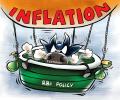
Analysts say RBI will cut rates because the liquidity crunch that began this time last year is still hurting the economy and also with an eye on the August industrial production numbers, which showed a contraction by 1.1 per cent -- the steepest in seven long years.

However, RBI would continue to nudge banks to cut lending rates

RBI may go for a 25-basis point cut at its February policy meet.
The stock markets, which had opened in the green on rate cut hopes, tumbled after the monetary policy announcement.
A spiralling inflation is likely to force the Reserve Bank of India to up the Cash Reserve Ratio by 0.75 per cent in FY 09, along with a 1 per cent hike in repo and reverse repo rates, global financial services major, StanChart said.

The Governor said the MPC had voted to maintain its accommodative stance, implying more rate cuts in the future if the need arises.

The bank said that it has retained interest rate on savings bank deposit at 3 per cent for customers with balances above Rs 100,000. Customers with SB balance up to Rs 100,000 will continue to get the rate of interest at 3.50 per cent despite cut in the repo rate by the RBI earlier this month.
.jpg)
Bankers remained ambivalent on the impact of Tuesday's policy announcement by Reserve Bank on the cost of funds and refrained from giving a guidance on the direction in which lending rates are headed.
The central bank has hiked however reverse repo rate by 0.25 per cent.
Housing loan, car loans, personal loans and education loan will get costlier in the months to come.
RBI sees marginal improvement in economic growth to 5-6%.
A CRR cut will help banks to reduce lending rates.
